|
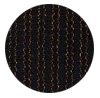
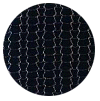
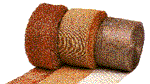
Knitted wire meshes |
 |
|
| The table shows a wide range of knitted wire meshes whose characteristics meet the most frequent use applications. |
|
| A |
B |
C |
D |
F |
G |
| 60 |
60 |
55 |
36 |
2 x 4 |
54,24 |
| 120 |
15 |
100 |
34 |
4,5 x 4
2,5 x 4 |
64,54 |
| 140 |
150 |
120 |
40 |
4,5 x 5,5
2,5 x 5,5 |
65 |
| 200 |
205 |
180 |
56 |
4 x 3,5
2,5 x 3,5 |
105,4 |
| 250 |
260 |
240 |
65 |
4 x 4
3 x 4 |
123,22 |
| 410 |
420 |
380 |
94 |
5,2 x 3,5
3 x 3,5 |
198 |
| 560 |
565 |
490 |
102 |
7,5 x 5
2 x 5 |
195,16 |
| 560 |
560 |
470 |
128 |
5 x 4
2,5 x 4 |
270 |
| Remark: Meshes become shorter on being corrugated. The maximum corrugation with our pinions shortens the mesh length by 59% |
A:It is the standard width of the mesh going out of the machine, once flattened (flattened pipe).
B:It is the maximum width the machine can deliver.
C:It is the minimum width the machine can deliver.
D:Number of machine needles.
F:Nesh opening. Also included in the nominal width. Two mesh openings machines.
The first opening is that between two needles.
The second is that of the hole of the needle itself, i.e.,there is one opening of each alternatively.
G:Weight of 1 linear m of that mesh, in grammes, 0,26f wire, AISI 304, mesh at rest not drawn. If the wire diameter is different the weight of the mesh is proportional to the wire section(*). Make the conversion according to the specific weight of each material for the different qualities.
(*)Section in the sense of the area (pr2).
|